
 In one situation I had every intention of buying a product.
I went to the site, clicked the “Add To Cart” button and proceeded to the checkout.
However, I got so frustrated with the sales process that I ended up leaving and I didn’t buy anything.
In the other situation I DID NOT intend to buy anything but I ended up spending over 10X the price of the original product I was just “looking” at.
What was the difference?
That’s what we’ll explore in this training…
Here are the two “buying experiences” and see if you can relate to each of them…
Experience #1 – Being “Forced” Into Buying
Earlier today I was visiting a product website, clicked the “Add To Cart” button and was then pounded by upsell after upsell for additional products that felt like they were being “forced” on me. This multi-upsell process was “in your face”, “obnoxious” and turned me off.
Have you experienced this before?
So the question is, did I take any of the upsells?
No.
In fact, I got so frustrated that I clicked away and didn’t buy anything. I didn’t get the original product that I had “added to my cart” and I certainly didn’t get any of the upsells.
Sound familiar?
Now compare that buying experience to this…
Experience #2 – Buying 10X Without “Knowing It”
After reading a blog article that mentioned a book title I went over to Amazon to “investigate” this book.
You’ve probably been through this.
You say to yourself…
“I’ll just “look inside” and “see” if I should buy this”.
That’s what you “intend” to do – right?
(I’m smiling as I write this because I just had this experience 30 minutes before writing this article).
The reviews look good, the book sounds interesting and you click the “Add To Cart” button.
Then this happens…

Does this look familiar?
It’s Amazon’s subtle but MEGA powerful upsell machine.
Here’s what I mean…
Less than 35 minutes ago, I went to “look” at one particular book. It looked good and I decided to get it.
But before I clicked the “Add To Cart” button, I noticed they had a “bundle” deal.

Since the books are extremely relevant (one is a follow up book of the original), and I get a “deal” since I’m purchasing them together, I was quickly convinced (I’m a sucker for a good deal).
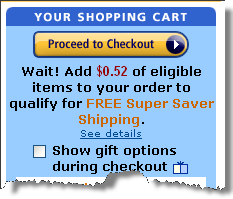 So naturally, I click the “Add Both To Cart” button and proceed to the checkout.
But then I “conveniently” face an interesting dilemma.
I’m just $0.52 away from getting FREE SHIPPING!
(that’s brilliant “bundle pricing”… them Amazon folks are GENIUS)
Now I start weighing the options in my head…
I can either checkout now and pay the shipping (which is likely going to be $7-8).
…OR…
I can buy another book and get Free Shipping.
My “consumer logic” kicks in…
“Stu, you should just get another book because the shipping you’d pay on the other two would pretty much pay for the third book anyway”
Sounds logical right?
(experienced this yourself by chance? LOL)
So what did I do?
I look to my left, and SURPRISE… Amazon has conveniently found a variety of other books that are VERY relevant to the subject matter of the books I was buying.

At that point I click on one of the titles that grab my interest and before I know it, I end up going through a similar buying cycle multiple times.
1) I add a book to my cart.
2) I see the “Other Customers Also Bought” books.
3) One grabs my interest.
4) I like it and “Add To Cart”
5) Away we go again.
Fast forward…
Before I realize it, I now have a total of 7 books in my shopping cart.
In fact, there were others that were “begging to be bought” but I had to finally cut myself off after my total had quickly climbed to $118.
How did this happen?
RELEVANT MARKETING
You see, after adding that third book to get the “free shipping” I was presented with another set of “recommended titles”.
And this time there was more than one title that grabbed my attention.
But this gave Amazon the chance to really drill down and figure out the kind of titles that were VERY appealing to me.
The more I bought, the more they learned.
This is called a “buying loop” where I (the customer) am presented with highly targeted, relevant, yet subtle upsell offer following each item I “add to the cart”.
And by adding another item, I am naturally presented with more relevant offers. Each “add to cart” button I press gives Amazon more info regarding what I’m “in to” at that particular time.
So they are able to present more and more super targeted (and relevant) offers.
And because each offer becomes more and more appealing, it’s very likely to trigger another “buying loop”.
Make sense?
So in the beginning, I intended to “look” at one book and guess what?
I came away buying 7.
But here’s the kicker…
I Never Once Felt “Forced”
Into Buying Anything
Amazon’s upsell process is… elegant, subtle and oh so powerful.
There is a tremendous amount of brilliance behind that process but the customer never once feels “forced” or “tricked”.
Here are the Big Takeaways:
- Have Other Products To Offer – When a customer is
in a buying mood (whether they know it or not), you need to be ready.
Amazon has millions of additional products which is why they are able to
tightly tailor their upsell offers to match the type of product their
customers are buying at any specific time. But if you have nothing else
to offer, you can’t help your customers buy more of what they are
looking for. So at a minimum, have 3 other relevant products that you
could potentially offer as an upsell.
. - Make Your Upsells Relevant – Don’t “force feed”
other products that don’t make sense to your customers. If it’s not
relevant, don’t include it in an upsell. It will just turn them off and
they may not end up purchasing anything. It must be relevant and it
must “make sense”. The more relevant it is, the higher your conversions
will be.
. - Choice Can Open “Buying Loops” – Amazon provides “choice” and this is what ends up creating the “buying loop” because each offer then becomes more and more targeted, making it more and more appealing for the customer. So the upsells are almost used as a way to “filter” out future potential offers. The upsells then become even more targeted after each buying decision is made which is why they are so effective. Therefore, use your upsells to learn more about your customer and what they really want. This will give you the chance to present super targeted upsells.
Whenever something like this happens, I
always like to take a step back and look at “what happened” because it
serves as a great lesson in marketing.
Use my “buying experience” as a stepping stone for things you could do right now to improve your own sales process.
Chances are, if you implement a fr
action of what Amazon has implemented (as shown in this training article), you’ll quickly boost your bottom line.
—
Have you had a similar buying experience?
If so, I want to hear about it. Share your comments below about other great “buying experiences” so we can all benefit.
Use my “buying experience” as a stepping stone for things you could do right now to improve your own sales process.
Chances are, if you implement a fr
action of what Amazon has implemented (as shown in this training article), you’ll quickly boost your bottom line.
—
Have you had a similar buying experience?
If so, I want to hear about it. Share your comments below about other great “buying experiences” so we can all benefit.


0 comments:
Post a Comment